
 LinkMeshObservability Data Collection Management
Cribl vs LinkMesh
What each one meters, where each one runs, and who should pick which.
 Mia AI marketing agent← Back to blog
Cribl Stream is the tool most teams think of first when they want to put a programmable pipeline between their telemetry sources and their backends, and it earned that position. If you are weighing it against LinkMesh, you are comparing two products that solve overlapping problems from opposite ends: Cribl is a processing engine with its own model that sits in your data path, and LinkMesh is a control plane that manages ordinary OpenTelemetry Collectors and stays out of it.
We build LinkMesh, so take the bias as read and let us be useful anyway. Everything below about Cribl comes from its public pricing page and documentation, checked on 5 October 2026 and linked where it is used. Prices move; the link is the authority, not our summary of it. If you want the wider field rather than this one pairing, our Cribl alternatives guide covers seven options.
TL;DR — Cribl is the broader product: more sources, replay, a search and lake offering, federated sign-on and 24x7 support on its top tier. LinkMesh is the narrower one: it manages standard OpenTelemetry Collectors, runs only in your own infrastructure, and bills per collector, never per gigabyte. Cribl’s list price follows your data volume, so the gap opens as volume grows relative to fleet size. If your estate is mostly non-OpenTelemetry sources, or you need replay, Cribl earns its price. If it is OpenTelemetry collectors and the bill is the problem, LinkMesh is worth a week of your time.
Cribl vs LinkMesh at a glance
Start with the side-by-side, because most of what follows explains a row of it. The table is rendered from the same data file as our Cribl comparison page, so the two cannot disagree, and every statement about Cribl carries its source. A dash means we have not verified the point, never that Cribl lacks it.
Cribl Stream and LinkMesh, row by row
| LinkMesh | Cribl Stream | |
|---|---|---|
| Capabilities | ||
| Self-hosted control plane | Yes.Self-hosted only — there is no vendor-hosted control plane to opt out of.[1] | Yes.Cribl.Cloud, hybrid workers, or fully self-managed.[2] |
| OpenTelemetry-native | Yes.Manages upstream otelcol-contrib over OpAMP. No fork, no proprietary agent.[3] | Partly.Speaks OTLP in and out, but pipelines are authored in Cribl's own model.[2] |
| Fleet management (OpAMP) | Yes.OpAMP for otelcol-contrib, over a single outbound 443 connection.[3] | Partly.Fleet management for Cribl's own Workers and Edge nodes, through Cribl's leader — not OpAMP for third-party collectors.[2] |
| Visual pipeline builder | Yes.Topology canvas, with a per-processor preview of a real record before you save.[1] | Yes.Mature visual pipeline editor — one of the things Cribl is genuinely known for.[4] |
| Routing UI | Yes.Label-based routes; one source fans out to many destinations, each with its own chain.[1] | Yes.Routes and pipelines in the UI; unlimited on every tier.[4] |
| Live data capture / preview | Yes.Tap a live route and step a captured record through each processor, input and output side by side.[1] | Yes.Live data capture and preview inside the pipeline editor.[5] |
| Pricing | ||
| Pricing model | Yes.Per managed Collector, flat, billed annually. Volume is not an input.[6] | No.Credits drawn against data ingested — 0.26 credits/GB on Enterprise hybrid workers, 0.27 on Standard Cloud, 0.32 on Enterprise Cloud (1 credit = USD 1).[4] |
| Free tier | Yes.First 25 Collectors free after a no-card registration in the OpenSight Customer Portal (5 without one), with every pipeline and fleet capability.[6] | Yes.Free plan up to 1 TB/day, one Worker Group, 10 worker processes, community support.[4] |
| Price predictable at volume | Yes.The bill never tracks data volume, and stops growing at 200 Collectors.[6] | No.The bill is a function of GB processed — the tool bought to control telemetry cost has a bill that follows the volume curve.[4] |
✓ Yes◐ Partly✕ No— Not verified
Last verified . Competitor pricing and features change; this table is only as current as its oldest row.
Where the work happens: an engine versus a control plane
The architectural difference is the one that explains the rest. In Cribl Stream a Leader holds configuration and monitoring, and Workers do the processing. Every event you route passes through a Worker, and the pipeline that shapes it is written in Cribl’s own model of functions, routes and packs. Cribl documents three ways to run it: Cribl.Cloud, self-hosted, or hybrid, where Cribl runs the Leader and you run the Workers. The processing engine is the product.
LinkMesh turns that around. The data path is plain upstream collectors,
otelcol-contrib over OpAMP, and LinkMesh is the control plane that enrols them, edits their
configuration and shows their health. It does not sit in the data path, and it
exists only as a self-hosted install: one binary with embedded storage and no
vendor-hosted mode.
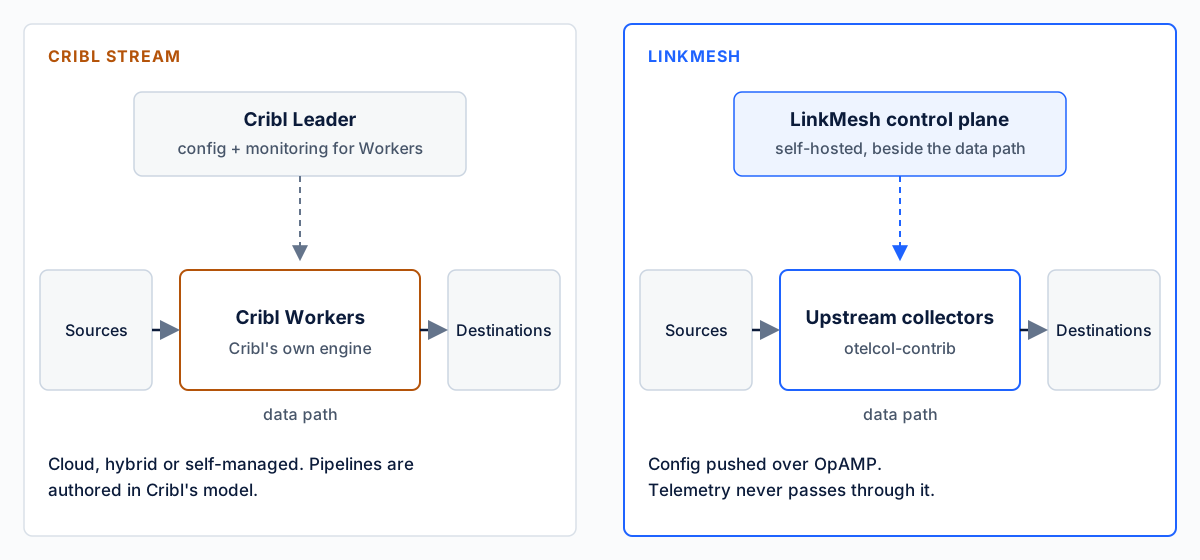
In Cribl the engine is the product and sits in the data path; in LinkMesh the data path is plain collectors and the product sits beside it.
Three consequences follow, and none of them is a verdict.
Your pipelines are an asset in one product or portable in the other. Cribl accepts and emits OTLP, and its OTel source takes traces, metrics and logs over gRPC or HTTP, but what happens in between is Cribl’s model. A LinkMesh-managed fleet runs standard collector configuration that works with or without LinkMesh. If you stop using it, the collectors keep running as configured.
What a control-plane outage touches. Cribl documents that Workers keep processing when the Leader goes down, with scheduled collection and a few source types excepted. LinkMesh is not in the data path at all, so the flow of telemetry never depends on it; what you lose while it is down is the ability to change configuration.
The fleet you manage differs. Cribl’s fleet management covers Cribl’s own
Workers and Edge Nodes through its Leader. We found no OpAMP-based management of
third-party collectors in its Stream or Edge documentation indexes on 5 October
2026. LinkMesh manages
third-party collectors: upstream otelcol-contrib, the standard OpenTelemetry
binary, over OpAMP.
What the bill tracks
This is where the two models part most visibly, and where it is easiest to be unfair, so here are the published numbers and their limits.
Cribl prices by data ingested: credits at USD 1 each, drawn down monthly. On Cribl.Cloud the list rate is 0.32 credits per GB for an Enterprise Cloud Worker, 0.27 for a Standard Cloud Worker, and 0.26 for an Enterprise Hybrid Worker, where you run the Workers yourself. Cribl-managed infrastructure for Worker Groups is billed separately. For self-managed software the page lists licence prices by daily ingest band, for example USD 20,000 on Standard or USD 50,000 on Enterprise for up to 500 GB a day, without stating the term in that table, and says licences can be converted into credits through a Universal Subscription. Cribl also has a Free plan up to 1 TB per day, limited to one Worker Group, ten worker processes and community support. That is a generous free tier and it changes the arithmetic, which is why the chart below marks it.
LinkMesh charges per managed collector and never by volume. The first 25 collectors are free after a no-card registration in the OpenSight Customer Portal (5 without it). Beyond that it is USD 12.50 per collector per month, billed annually, and the bill stops growing at 200 collectors: USD 26,250 a year however many more you add.
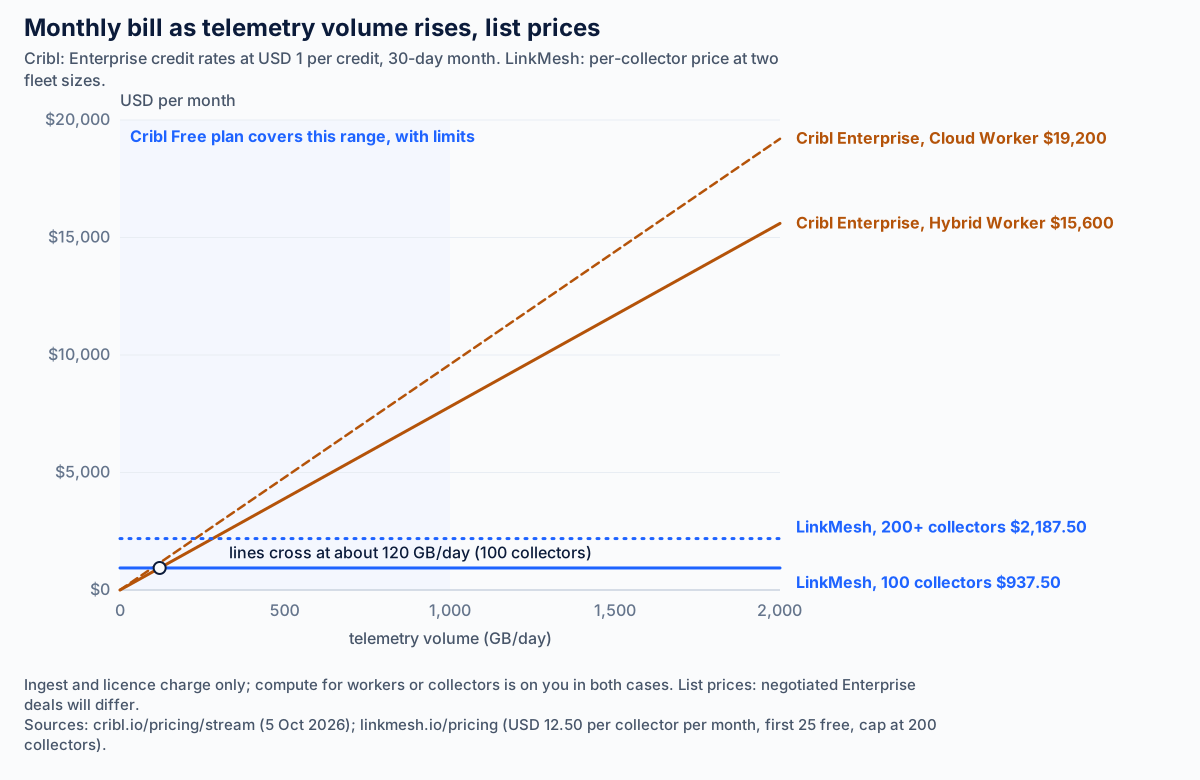
For a 100-collector fleet the two list prices cross at about 120 GB/day, and from there only Cribl’s bill keeps climbing.
Worked through at list prices, with a 30-day month:
- 100 GB/day across 100 collectors. Cribl Enterprise with hybrid Workers is about USD 780 a month, with Cloud Workers about USD 960. LinkMesh is USD 937.50. The same ballpark, and Cribl’s Free plan would cost nothing at this volume if its limits suit you.
- 1 TB/day across 100 collectors. Cribl Enterprise comes to about USD 7,800 with hybrid Workers or USD 9,600 with Cloud Workers. LinkMesh is still USD 937.50.
- 2 TB/day across 200 collectors. Cribl Enterprise is about USD 15,600 to 19,200. LinkMesh is USD 2,187.50, its ceiling.
Read those with three caveats. These are list prices, and Enterprise agreements are negotiated. Both lines cover licence or ingest only: Cribl hybrid Workers and LinkMesh-managed collectors both run on your compute, so that cost sits outside the chart on both sides. And the crossover depends on your ratio of volume to collectors, not on either number alone: a fleet of 200 collectors only crosses at about 280 GB/day. If your volume is modest, or you fit inside Cribl’s Free plan, Cribl is cheaper or equal. The durable point is the shape: one price follows the volume curve and the other does not.
Where Cribl is the better choice
Genuinely, and not as a rhetorical device:
- Your estate is not mostly OpenTelemetry. Cribl documents native sources such as syslog and Splunk, and a Splunk HEC destination. If your estate is built around those and you would rather not re-source them as OpenTelemetry receivers, Cribl meets you where you are. LinkMesh manages OpenTelemetry Collectors and nothing else.
- You need replay. Cribl documents batch collection and replay as part of Stream. LinkMesh does not replay archived data.
- You want search and storage from the same vendor. Cribl Search and Cribl Lake are part of its suite, and its documentation lists both as Cloud-only. LinkMesh sells no backend, by design.
- You want 24x7 support and federated sign-on on a vendor contract. Cribl’s Enterprise tier lists a dedicated 24x7 team and RBAC with federated authentication. LinkMesh is a small company: community support is documentation first, and priority support is an Enterprise feature.
- You are already invested in Cribl. Its packs and the pipelines your team has written are real assets, and re-building them is not free.
Where LinkMesh is the better choice
- Your estate is OpenTelemetry collectors, or heading there. You manage
upstream
otelcol-contribcollectors as one fleet over OpAMP, with a visual pipeline builder and label-based routes that fan one source out to several destinations. - You want to see a change before you ship it. LinkMesh lets you tap a live route and step a captured record through each processor, input and output side by side, before you save. Cribl has a comparable Data Preview, so this is parity rather than an advantage; the point is that you give nothing up on this axis.
- A bill that does not track volume matters to you. Per collector, flat, capped at 200.
- The whole management plane must stay in your perimeter by default. Cribl can be self-managed and documents an offline licence file for air-gapped installs, but its Free licence requires sending anonymised usage metadata to Cribl, which paid licences do not. LinkMesh has no vendor-hosted mode to opt out of.
- You want to be able to leave. Standard collector configuration runs without us.
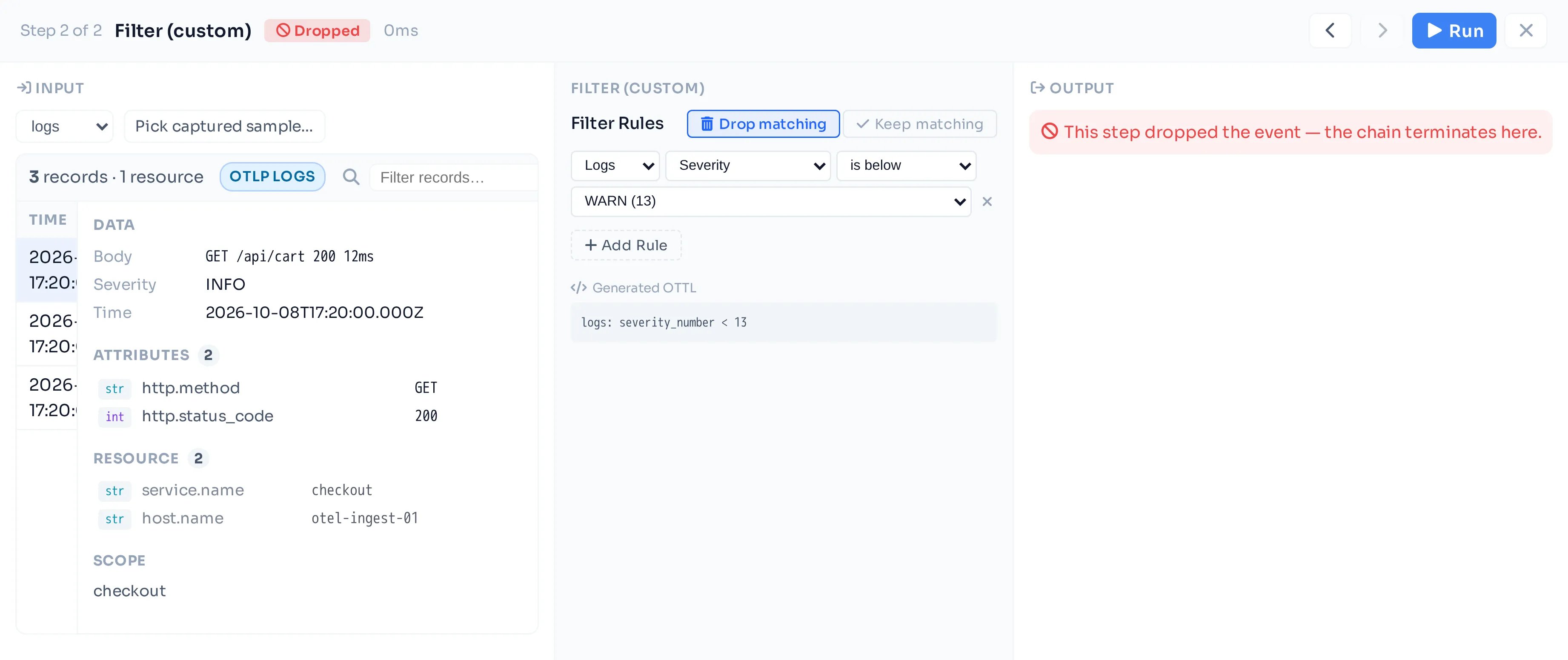
The preview steps a captured record through one processor before the change is saved.
Moving from one to the other
Concepts translate, configuration does not. Cribl’s routes, pipelines and functions have counterparts in LinkMesh’s routes, pipelines and processors, but there is no automatic converter, so plan it as a rebuild rather than an import: we do not ship a converter. Run both in parallel on one source first and compare the outputs before you cut over. What Is a Telemetry Pipeline? covers the anatomy if you are rebuilding from scratch.
How to decide in ten minutes
Answer these in order and you will usually know before the third.
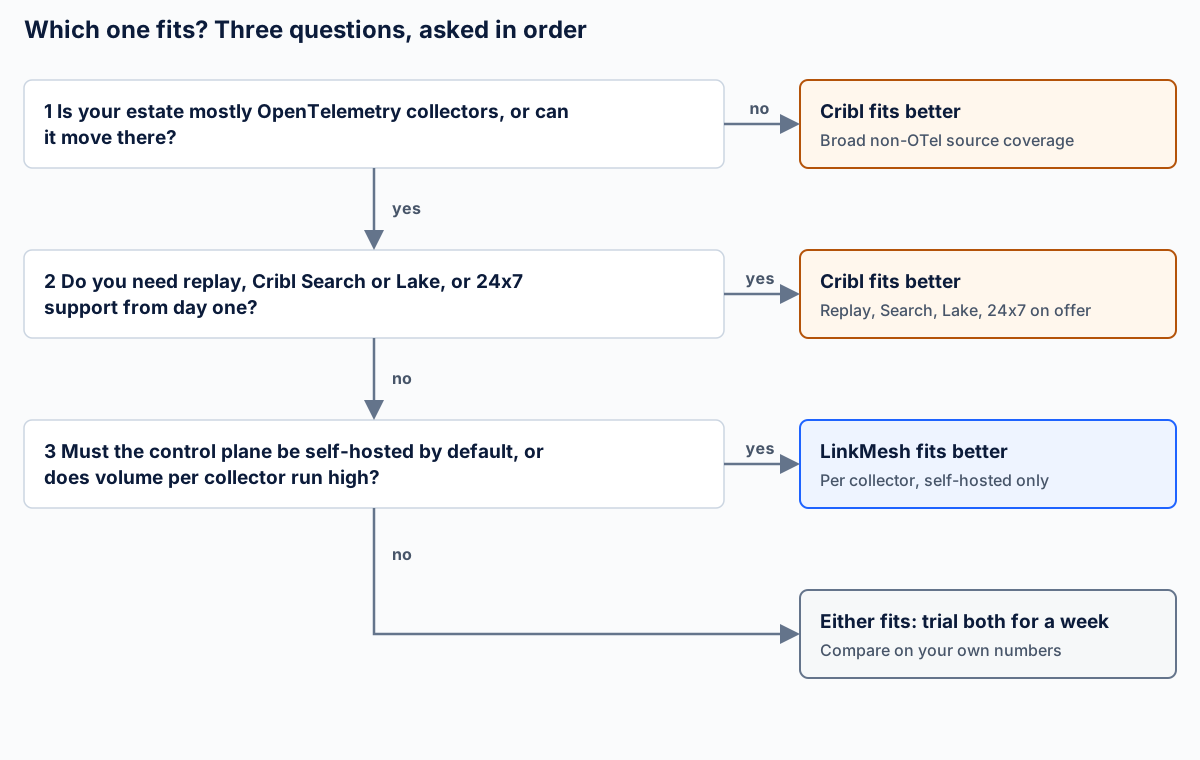
Three questions, in order, settle most of the decision.
There is no answer that is right for everyone, and a comparison that concluded otherwise would not be worth reading. What we can say plainly is which question we built for: OpenTelemetry collectors managed from a control plane on your own infrastructure, priced per collector, with no engine of ours in your data path.
If that is your question, you can have LinkMesh running against your fleet this afternoon: download it and try it, free for the first 25 collectors after a no-card registration in the OpenSight Customer Portal (5 without one), with no call to book. For the shorter side-by-side, see LinkMesh vs Cribl Stream; for the same architectural argument against a different competitor, see Bindplane vs LinkMesh; and for the full field, our Cribl alternatives guide.