

 LinkMeshObservability Data Collection Management
Bindplane vs LinkMesh
One architectural question decides this — and it isn't the feature list.
 Philippe Braxmeier← Back to blog
If you are choosing a way to manage an OpenTelemetry Collector fleet, Bindplane is the product you should compare us against. It is the closest peer LinkMesh has: OpenTelemetry-native, OpAMP-based, a visual pipeline builder, and fleet management as the actual product rather than a feature bolted onto a backend. Most other names in the category differ from us on some structural axis. Bindplane differs on a much narrower one — and that makes this the comparison a serious evaluator actually runs.
We build LinkMesh, so take the bias as read and let us be useful anyway. Everything below about Bindplane comes from their own public pricing page and documentation, checked on 10 September 2026 and linked at the point of use. Pricing pages move; the link is the authority, not our summary of it.
TL;DR — Both manage OTel collector fleets over OpAMP, and both keep your telemetry out of the vendor’s hands. They part company on one thing: Bindplane’s control plane is vendor-hosted, and the self-hosted option is listed against the Enterprise tier alone. LinkMesh is self-hosted at every tier, including the free one, because self-hosted is the only mode it has. If a vendor-hosted control plane is fine for you, Bindplane is a strong product with a large company behind it. If your control plane must live inside your perimeter, that is a sales conversation at Bindplane and a download at LinkMesh.
What the two have in common
Start with the overlap, because it is large and it is the reason this comparison is worth running at all.
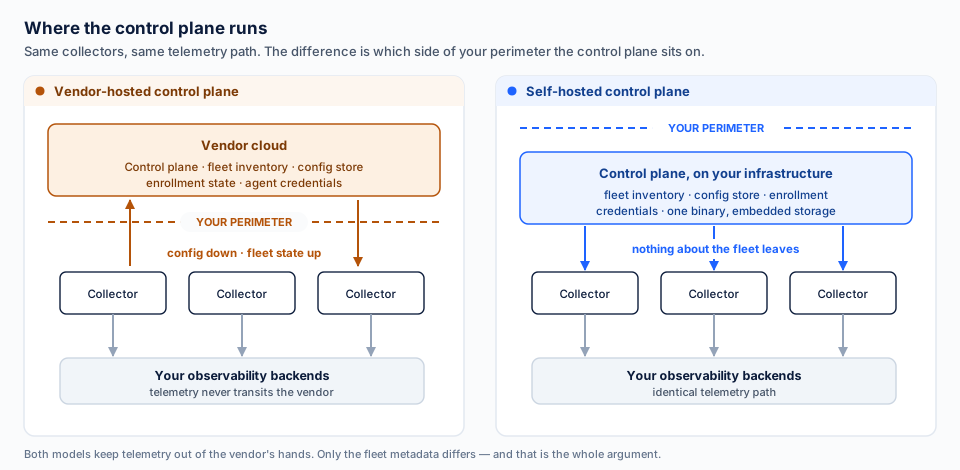
Both speak OpAMP to manage collectors rather than inventing a proprietary agent protocol. Both give you a central place to see the fleet, push configuration to it, and watch health. Both build pipelines through a UI instead of hand-editing YAML on every host. And — this is the one people get wrong — neither of them puts your telemetry through the vendor. In both products the data plane stays yours: collectors send to your backends directly. The control plane manages configuration; it is not in the data path.
So the honest framing is not “one of these leaks your data.” It is: which side of your perimeter does the thing that configures your fleet sit on, and what does it know about you?
The dividing line: where the control plane runs
A control plane is not in your data path, but it is not nothing either. It holds the fleet inventory — every host running a collector, what it runs, what version, when it last checked in. It holds the configuration for those collectors, which describes your internal service names, your log paths, your destinations. It holds the enrollment state and the credentials each collector uses to authenticate.
That is a fairly complete map of your estate, and where it lives is a real architectural decision. For most teams a vendor-hosted control plane is a perfectly good answer, and paying somebody else to run it is the right call. For some teams it is not available at any price — regulated environments, airgapped networks, or a security review that will not accept fleet metadata leaving the network boundary.
LinkMesh exists for the second group. That is the whole positioning, and it is narrower than “we are better.”
Self-hosting is a tier at Bindplane and the only mode at LinkMesh
This is the part worth checking carefully, because it is easy to read Bindplane’s marketing as “it does both” and stop there. It does do both. The question is on which terms.
On bindplane.com/pricing as of 10 September 2026, the feature matrix lists “Self-hosted option” against Enterprise only, and their own FAQ answers the question directly: “Yes, Enterprise customers have the option to host the Bindplane…”. Free and Growth are vendor-hosted. Enterprise is custom-priced and reached through sales.
LinkMesh has no vendor-hosted mode to choose between. The Community tier is free for up to 25 managed collectors with the full feature set and no time limit. You register the deployment in the OpenSight Customer Portal to get it; an unregistered install manages 5. It is self-hosted — one binary with embedded storage, no external database, no worker tier. So is the paid tier. There is nothing to upgrade to in order to keep the control plane inside your network, because there is nowhere else for it to run.
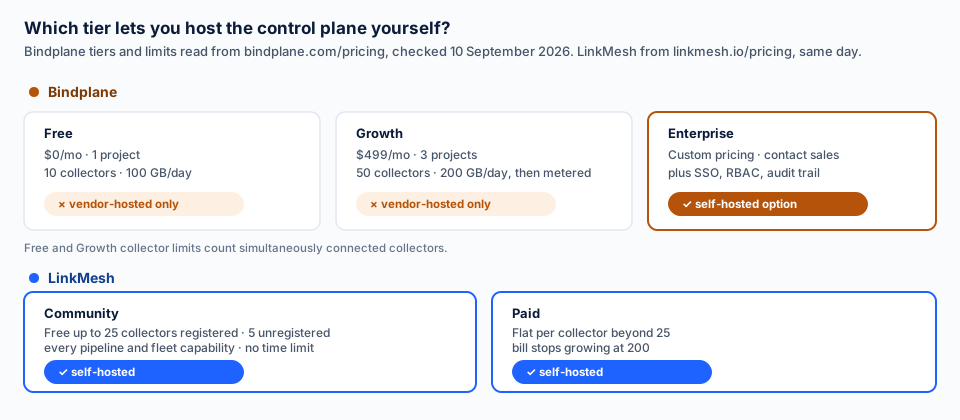
Practically, that changes what evaluating looks like. Trying a self-hosted Bindplane means starting a conversation with a salesperson at a Dynatrace company. Trying a self-hosted LinkMesh means downloading a binary this afternoon. Neither of those is a statement about product quality — but if you are the engineer who has to demonstrate something works before anyone will fund it, they are very different weeks.
What the bill tracks
Both products are commercial. They meter different things, and that difference compounds in a way a feature table hides.
Bindplane’s published tiers charge for both collector count and data volume above each tier’s allowance: Free covers 10 collectors and 100 GB/day, Growth is $499/month for 50 collectors and 200 GB/day, with $1.50 per additional collector per month and $0.28 per additional GB. (The collector limits on Free and Growth count simultaneously connected collectors.)
LinkMesh charges per managed collector and never by volume. Beyond the free 25 it is a flat per-collector monthly price, and the bill stops growing entirely at 200 collectors. You can push 100 GB or 100 TB through a managed collector for the same price. Your backend may well charge you by volume — that is a real cost and we are not pretending otherwise — but the fleet management layer does not add a second volume-scaled bill on top of it.
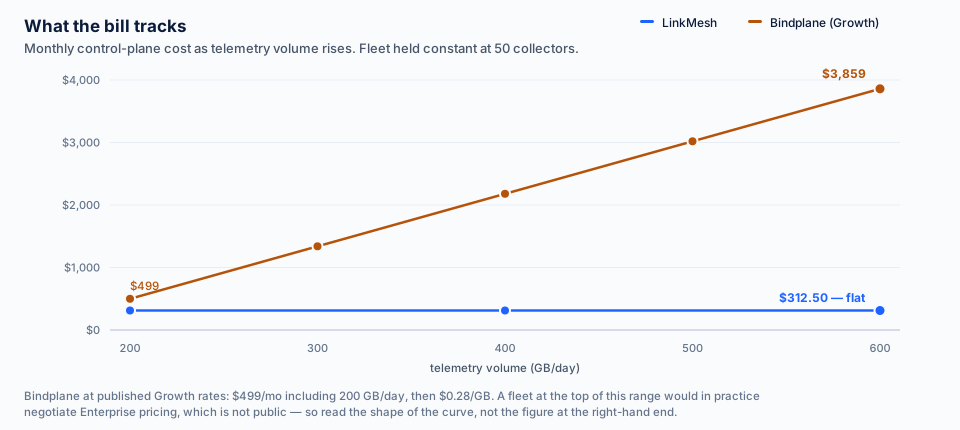
Read the shape of that curve rather than the number at the right-hand end. A fleet genuinely running 600 GB/day would be negotiating Enterprise pricing, which is not public, so the top of the range is an extrapolation of published rates rather than a quote anyone would actually pay. The durable point is the direction: one line is flat because volume is not an input to it, and the other is not.
Who owns the layer that routes your telemetry
Bindplane has been part of Dynatrace since April 2026 — announced on 8 April 2026, and their site still carries the “Bindplane is excited to join Dynatrace!” banner today.
This cuts both ways and our copy should too. Dynatrace backing genuinely strengthens Bindplane for a buyer who wants a large vendor, enterprise support commitments, and pipeline-plus-backend from one supplier. That is a real advantage and it is not one we can match.
It is also the fourth time in recent memory that the independent, backend-neutral pipeline layer has been bought by an observability vendor. If it matters to you that the tool deciding where your telemetry goes is not owned by a company that also sells a destination for it, that is a smaller field than it was a year ago. Whether that concern is worth anything depends entirely on your situation — plenty of teams are already all-in on one vendor and lose nothing.
OpenSight is independent and sells no observability backend. We have no destination to steer you toward, which is easy to say and only meaningful because we have nothing to gain from it.
Which collector you actually run
LinkMesh manages vanilla upstream collectors — otelcol-contrib over OpAMP,
or Grafana Alloy over remotecfg. There is no LinkMesh fork of the Collector, and
nothing we ship has to be in the data path for the management layer to work. If
you stop using LinkMesh, your collectors keep running exactly as configured.
Bindplane’s collector is, in their words, “a distribution of OpenTelemetry” — their own build, actively maintained and Apache-2.0 licensed. In practice this is a mild lock-in, not a severe one: it is still OpenTelemetry underneath. But a distribution is a thing you adopt, and adopting the vendor’s build is one more decision that has to be unwound if you change your mind.
When Bindplane is the better choice
Genuinely, and not as a rhetorical device:
- You want somebody else to run the control plane. That is most teams, and it is a legitimate preference rather than a compromise.
- You need SSO, role-based access control and an audit trail today. Bindplane lists all three on its Enterprise tier. LinkMesh does not ship them yet, and for an organisation with a real access-governance requirement that alone can decide it.
- You want a large vendor behind the product, with enterprise support commitments and a company that will still exist in five years. Two people in Switzerland is a different risk profile, and pretending otherwise would be insulting.
- You are already a Dynatrace shop. The integration story is going to get better for you, not worse.
When LinkMesh is the better choice
- The control plane must be inside your perimeter — regulated, airgapped, or simply a security review that will not pass fleet metadata leaving the network. At LinkMesh that is the default rather than a tier.
- You want to evaluate without talking to anyone. Download it, run it against 25 collectors — a free Customer Portal registration lifts an unregistered install’s 5-collector limit — and keep it at zero cost indefinitely.
- You want a bill that does not track ingest. Per collector, flat, capped.
- You want to keep running upstream collectors with no vendor distribution and no fork.
- Independence matters to you — the layer routing your telemetry is not owned by a company selling you somewhere to send it.
How to decide in ten minutes
Answer these in order and you will usually know before the fourth:
- Can your control plane be vendor-hosted? If yes, Bindplane’s free and Growth tiers are the fastest path to a working fleet and you should try them. If no, Bindplane means Enterprise and a sales cycle.
- Do you need SSO, RBAC or an audit trail on day one? If yes, that is Bindplane today.
- Does your telemetry volume grow faster than your host count? If yes, compare the two bills at your projected volume, not today’s.
- Would a vendor distribution of the Collector bother you in two years? If yes, that is a point for upstream.
There is no answer here that is right for everyone, and a comparison that concluded otherwise would not be worth reading. What we can say plainly is which question we built for: the control plane on your own infrastructure, priced per collector, running upstream collectors, from a company with no backend to sell you.
If that is your question, you can have LinkMesh running against your fleet this afternoon — download it and try it, free for the first 25 collectors after a no-card registration in the OpenSight Customer Portal (5 without one), with no call to book. For the shorter side-by-side, see LinkMesh vs Bindplane; for the same architectural argument applied to a different competitor, see Grafana Fleet Management vs LinkMesh.