

 LinkMeshObservability Data Collection Management
Cribl Alternatives (2026)
Self-hosted, OpenTelemetry-native options — compared honestly.
 Philippe Braxmeier← Back to blog
Cribl Stream popularized a genuinely useful idea: put a programmable pipeline between your telemetry sources and your observability backends, and suddenly you can reduce volume, reshape data, and route it wherever you want. It’s a strong product. But it isn’t the only way to get those benefits, and for a lot of teams it isn’t the cheapest or the most open one.
If you’re evaluating a Cribl alternative — whether for pricing, for self-hosting, or because you want something built on open standards — this guide walks through seven credible options for 2026, what each is good at, and an honest note on when Cribl is still the right choice.
Why teams look beyond Cribl
Three reasons come up again and again.
Pricing at volume. Cribl’s model is tied to the amount of data you push through it. That’s fair — you pay for what you process — but it means the tool you bought to control telemetry cost has a bill that also grows with volume. Past a certain scale, teams start looking for a price model that doesn’t track their data curve.
The SaaS control plane. Cribl can be self-managed, but a lot of its momentum is around Cribl.Cloud, where the control plane (and often the data path) lives in the vendor’s environment. For regulated data or strict egress rules, teams want the processing and the management plane to stay on infrastructure they own.
Open-standards and lock-in concerns. Cribl has its own pipeline model and packs. It supports OpenTelemetry, but it isn’t OTel-native at its core. Teams standardizing on OpenTelemetry — OTLP everywhere, collectors they can swap — often prefer a tool that speaks that language natively rather than translating into a proprietary model.
None of these make Cribl a bad product. They’re just the seams where an alternative can fit better.
What to evaluate in a telemetry pipeline
Before the list, here’s the rubric worth scoring each option against. (If you want the fundamentals first, our What Is a Telemetry Pipeline? guide covers the anatomy.)
- OpenTelemetry-nativeness. Does it speak OTLP and manage OTel Collectors directly, or does it wrap them in its own model?
- Self-hosting. Can you run the whole thing — control plane included — on your own infrastructure, so telemetry never leaves your network?
- UI and routing capability. Cribl’s edge is a visual, Cribl-style routing model — one stream fanned out to many destinations by rule. How close does the alternative get?
- PII handling. Can you mask or drop sensitive fields before data crosses the network boundary?
- Price model. Volume-based, per-node, per-seat, or free? Does the bill track your data growth?
The whole reason the category exists is that last routing picture — one pipeline in, many destinations out, each getting only what it should:
The alternatives
A fair rule up front: capabilities in this space change fast. Treat the notes below as a starting map, and verify current details with each project before you commit.
1. DIY OpenTelemetry Collector
The baseline. The OpenTelemetry Collector is free, open source, and the reference implementation for receiving, processing, and exporting telemetry. With receivers, processors, and exporters wired in YAML you can build a very capable pipeline — filtering, batching, attribute manipulation, tail sampling, routing.
Good when: you want zero license cost and full control, and you have the engineering time to manage config and versions across a fleet yourself. The catch: there’s no UI and no fleet management. Every collector is its own config file to keep in sync — which is exactly the gap the rest of this list fills.
2. Vector
Vector (open source, MPL-2.0, stewarded by Datadog) is a high-performance pipeline written in Rust. Its transform language (VRL) is expressive, it’s fast and memory-efficient, and it handles logs and metrics routing very well.
Good when: you want a fast, self-hosted, config-driven pipeline and you’re comfortable managing it as code. The catch: like the raw Collector, it’s a config-file tool — no visual routing UI or built-in fleet control plane — and its model is Vector’s own rather than OTel-native (though it has OTLP sources and sinks).
3. Grafana Alloy
Grafana Alloy is Grafana’s open-source (Apache
2.0) OpenTelemetry Collector distribution — the successor to Grafana Agent. It
speaks OTLP, Prometheus, and Loki natively, and its remotecfg mechanism lets a
central server push configuration to a fleet.
Good when: you’re in the Grafana ecosystem and want an open, OTel-native collector with a path to remote configuration. The catch: Alloy is the collector, not a full pipeline-management product — the visual builder and fleet-wide control plane are things you add around it (Grafana Cloud’s fleet management, or a tool like LinkMesh).
4. Bindplane
Bindplane (from observIQ, part of Dynatrace since April 2026) is the closest in spirit to Cribl-as-a-management-layer while staying OpenTelemetry-native. It manages OTel Collectors, has a visual pipeline UI, and offers a free tier alongside commercial tiers, with self-hosting available.
Good when: you want OTel-native collector management with a UI and are choosing between a free tier and a supported commercial tier. The catch: the richest capabilities sit in the commercial tiers — worth mapping your must-haves against the tier boundary, and worth deciding how much weight you put on the pipeline now being owned by a vendor that also sells an observability backend.
5. Chronosphere Telemetry Pipeline
Chronosphere’s telemetry pipeline (built on the Calyptia / Fluent Bit lineage) is a commercial pipeline with strong reduction and routing, a management UI, and fleet control.
Good when: you want a mature, supported commercial pipeline, especially if you’re already invested in the Fluent Bit / Fluentd world. The catch: it’s Fluent Bit-native rather than OpenTelemetry-native at the core, and it’s a commercial product with a SaaS control plane — check where the data path and management plane run against your egress requirements.
6. Edge Delta
Edge Delta pushes processing to the edge: agents analyze and reduce telemetry close to the source before forwarding, which can cut volume dramatically.
Good when: edge-side pre-processing and anomaly detection are the priority and a SaaS platform fits your model. The catch: it’s a commercial SaaS platform, so the control plane isn’t something you self-host — the opposite end of the spectrum from a DIY Collector.
7. LinkMesh
LinkMesh is a self-hosted control plane for OpenTelemetry collectors. You point any collector — otelcol-contrib via OpAMP, or Grafana Alloy via remotecfg — at LinkMesh with one config block and a token, then compose sources, processors, routes, and destinations in a visual UI. LinkMesh renders and validates the collector config and pushes it to the right nodes; the telemetry itself never flows through LinkMesh — it stays on your infrastructure.
Good when: you want Cribl-style visual routing and fleet management, but self-hosted, OpenTelemetry-native, and priced per managed collector rather than by data volume. The catch: it’s a younger product focused on the OTel/Alloy world — if you need dozens of proprietary source integrations out of the box today, weigh that against the open-standards footprint.
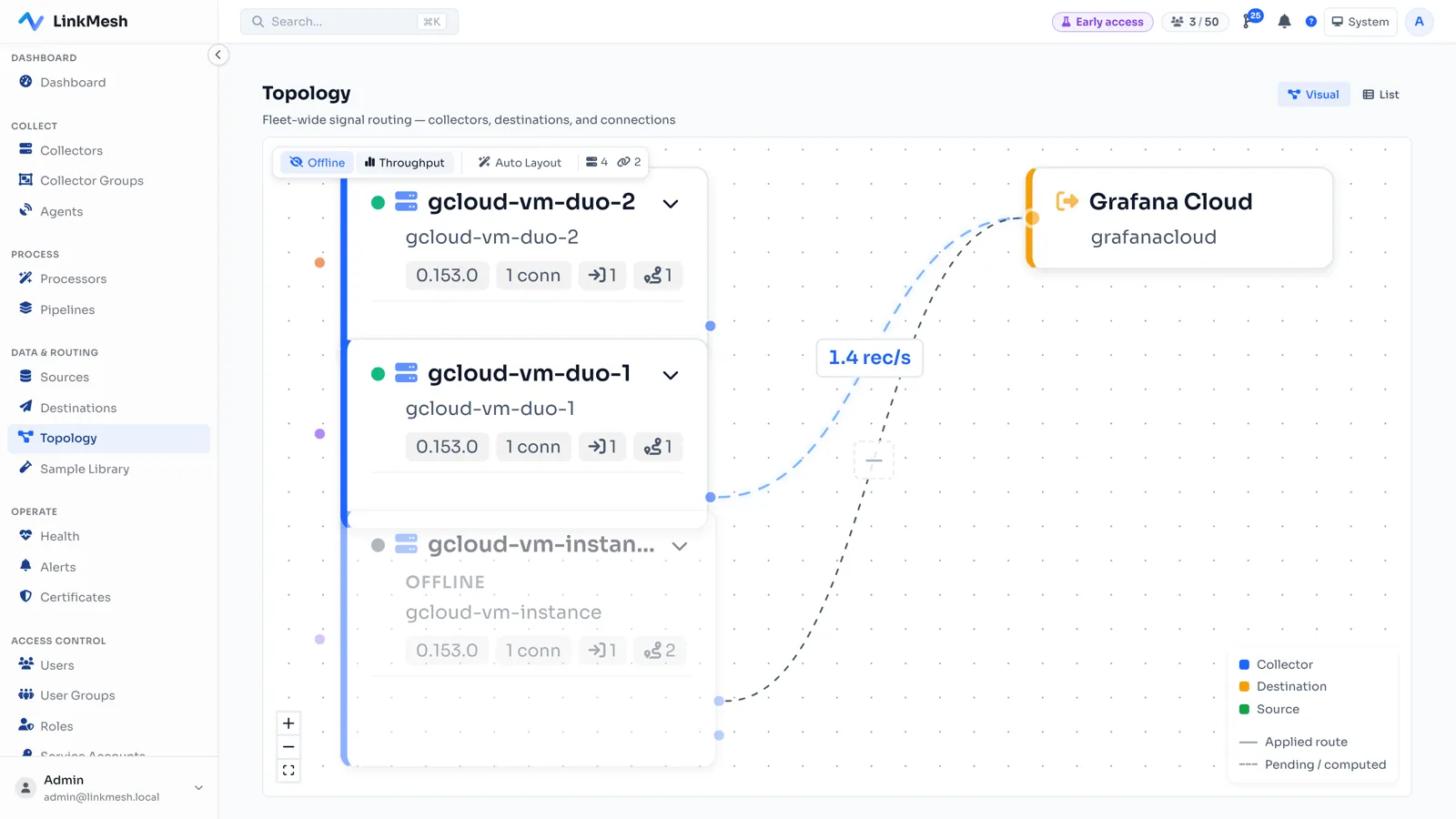
Here’s the Cribl-style routing canvas — collectors meshed through to destinations, throughput on every edge:
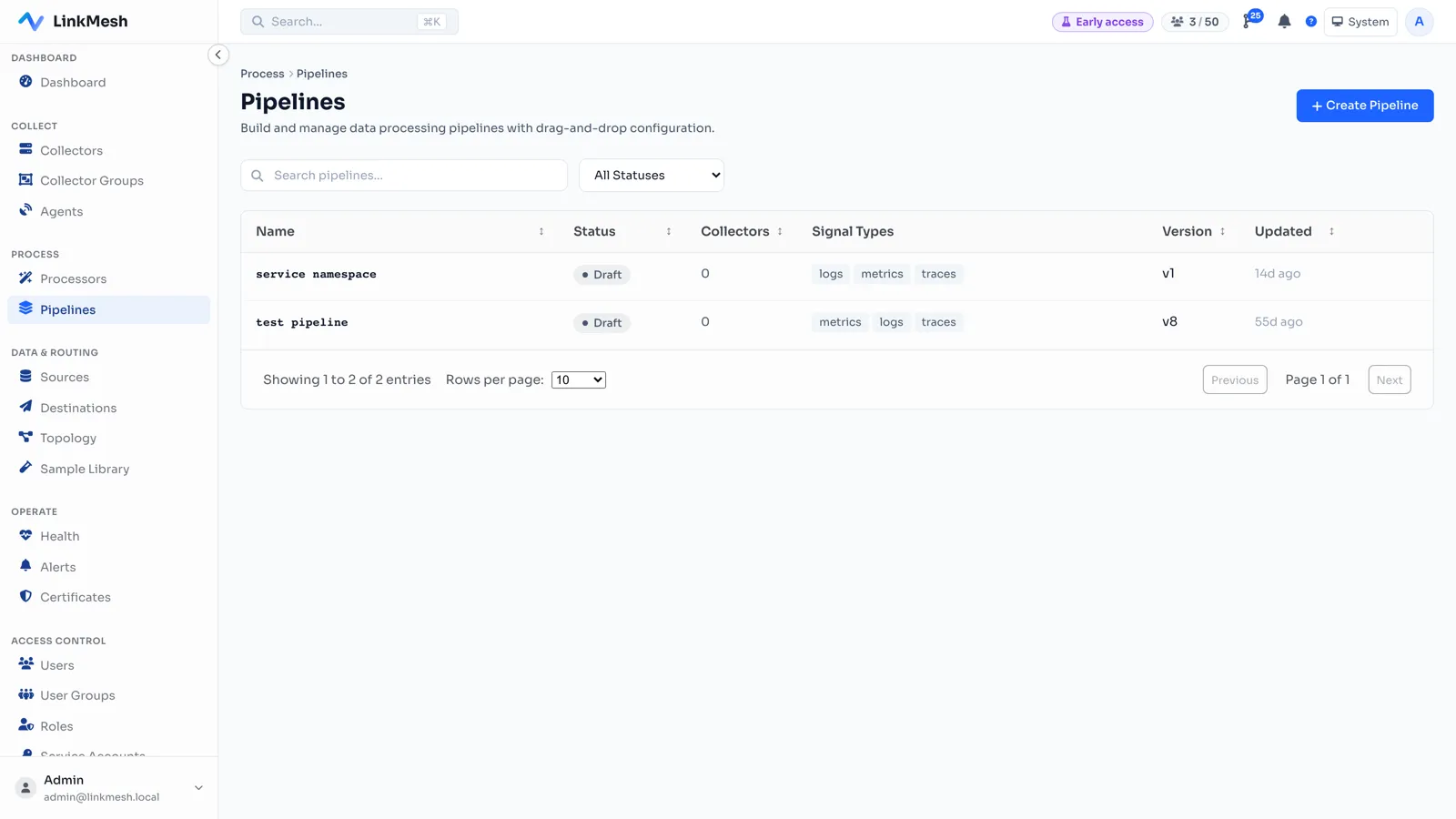
…and the pipeline builder where sources, processors, and destinations are composed:
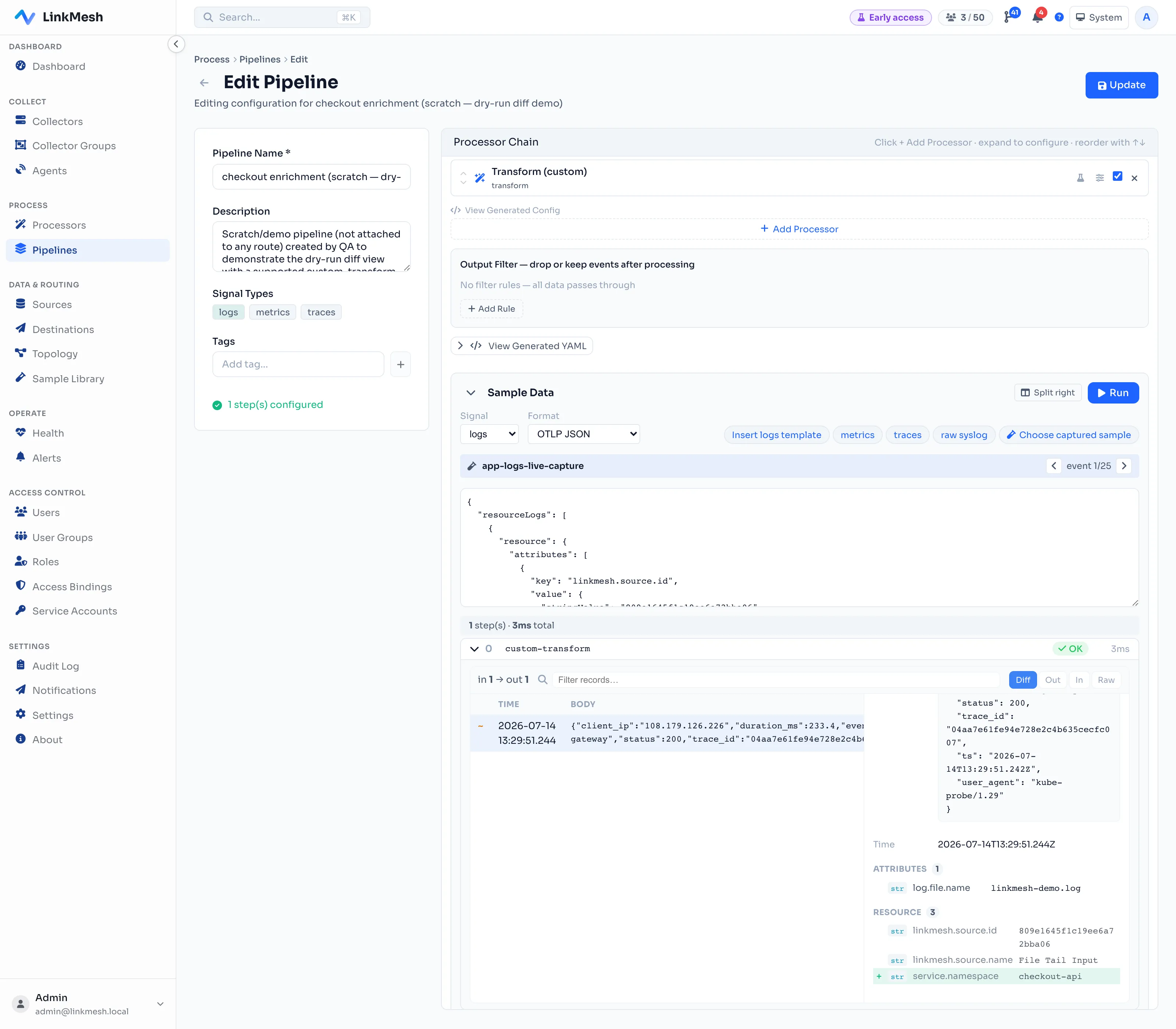
And — like Cribl’s capture-and-preview loop — you can test a pipeline against a real captured sample before shipping it. The dry-run runs your processor chain against the sample and shows a semantic diff: exactly which attributes each step adds, changes, or drops, field by field.
The routing side of that visual UI is a priority-ordered, first-match-wins cascade — the same Cribl-style model — with conditions built via a field/operator/value picker rather than raw OTTL, plus destinations you join to routes by label instead of wiring in one by one. That’s covered in depth in Route Telemetry by Attribute.
Comparison table
| Tool | Self-hosted? | OTel-native? | Visual UI? | Fleet mgmt? | License / price |
|---|---|---|---|---|---|
| Cribl Stream | Yes (or SaaS) | Partial | Yes | Yes | Proprietary · free tier, then volume-based |
| OTel Collector (DIY) | Yes | Yes | No | No | Apache 2.0 · free |
| Vector | Yes | Partial | No | No | MPL 2.0 · free |
| Grafana Alloy | Yes | Yes | Limited | Partial (remotecfg) | Apache 2.0 · free |
| Bindplane | Yes | Yes | Yes | Yes | Commercial · free tier |
| Chronosphere Pipeline | Partial (SaaS plane) | Partial (Fluent Bit) | Yes | Yes | Commercial |
| Edge Delta | No (SaaS) | Partial | Yes | Yes | Commercial |
| LinkMesh | Yes | Yes | Yes | Yes | Commercial · per-collector, free to start |
“Partial” is a judgment call, not a knock — and vendor capabilities move quickly. Verify the specifics that matter to you with each project’s current docs before deciding.
When Cribl is still the right choice
An honest comparison has to say where the incumbent wins. Reach for Cribl when:
- You need its breadth of source and destination integrations and packs on day one, across a heterogeneous, non-OTel estate.
- You want a mature, heavily-supported commercial product with a large community, extensive docs, and enterprise support behind it.
- Its routing and reduction features specifically map to a workflow your team has already built around — replatforming has a cost, and “good enough and familiar” often beats “better on paper.”
If those describe you, Cribl earning its keep is a perfectly good outcome. The point of this list isn’t that Cribl is wrong — it’s that “programmable telemetry pipeline” is now a category with real range, from a free Collector you run yourself to self-hosted control planes to full SaaS platforms.
If the axis you care about is self-hosted, OpenTelemetry-native, and priced by collector instead of by volume, that’s exactly where LinkMesh sits. See pricing or what it does, and you can stand one up and enroll your first collector in a few minutes at linkmesh.io/install.