
Standardise the fleet
Agree resource attributes, source settings and destination rules. Use collector groups to apply shared configuration to the intended environments.
Self-hosted OpenTelemetry control plane
Standardise collector configurations and telemetry pipelines across on-premises, Azure and Kubernetes. Give platform teams a shared management layer while retaining control over deployment and telemetry destinations.
25 Collectors free after a no-card registration · 5 without one How the free tier works
For platform and observability teams coordinating application, security and operations requirements. Agree ownership and repeatable configuration before scaling a central observability platform across environments.
Agree resource attributes, source settings and destination rules. Use collector groups to apply shared configuration to the intended environments.
Inspect configuration history and differences. Define who can save changes and how your team verifies the result. Saving applies configuration; it is not a draft awaiting approval.
Start with one on-premises workload and one Kubernetes workload. Verify the supported collector runtime, connectivity and data arriving at your backend before extending the blueprint.
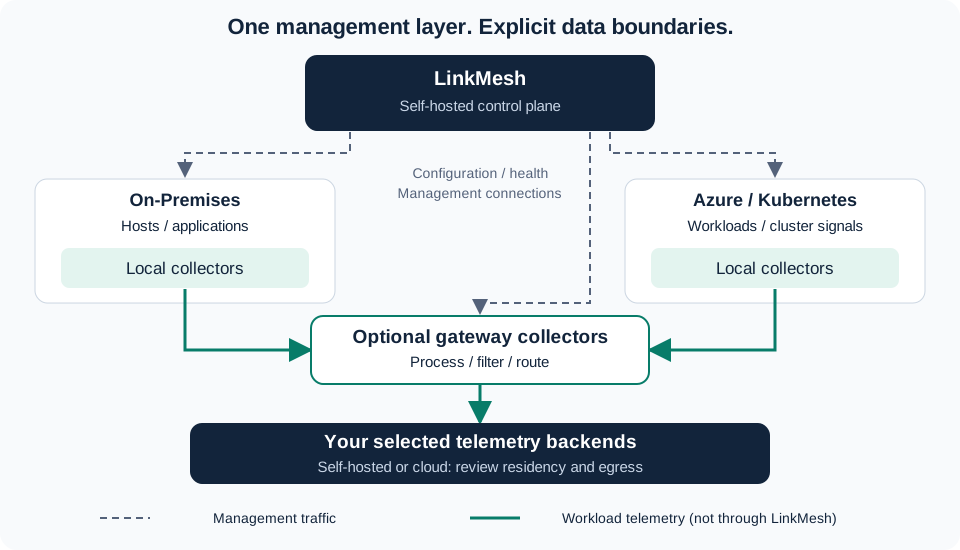
Allow each collector to reach the control-plane endpoint and its configured data destinations. Design TLS, proxies, identity and failure boundaries explicitly. Diagnostic sample capture is a separate workflow that also needs a data-handling review.
You operate the control plane. Collectors send workload telemetry to the destinations you configure; cloud destinations still involve cloud egress. Inventory, configuration, health and collector self-telemetry belong in the management-plane review.
Validate roles, group scopes, OIDC and service-account requirements against the current edition and documentation. Do not equate central management with an approved enterprise IAM integration.
The external Git repository is a history mirror, not an inbound deployment source. Use separate test groups and an explicit change process. Do not assume automated progressive rollout or pull-request approval gates.
Validate the licensed rollback operation. Version history does not restore source/destination settings or secret values. Record those separately and rehearse recovery before production changes.
Keep incident workflows, service ownership and dashboard provisioning in the architecture as explicit integrations. LinkMesh manages collectors and pipelines; it does not replace the observability backend or ITSM platform.
An offline design needs package mirrors, certificate and licence processes, backups and reachable destinations. BYOK/KMS integration and regulatory acceptance require specific evidence; self-hosting alone proves neither.
Evaluate that design with supported collector versions and approved network routes. AKS and OpenShift workload collection also depends on cluster permissions, security policies and the selected receivers; a generic Kubernetes diagram is not a compatibility certificate.
No. It gives you deployment control. Your organisation must assess data classification, access, retention, encryption, operations and external dependencies against its requirements.
It provides the collector-management layer. Storage, queries, dashboards, alerting and service-management workflows remain responsibilities of the selected backends and connected systems.
Bring your collector inventory, target backends, network boundaries and required controls. Pricing is based on managed collectors; verify the edition needed for automation, SSO and rollback.
Start with one test collector.
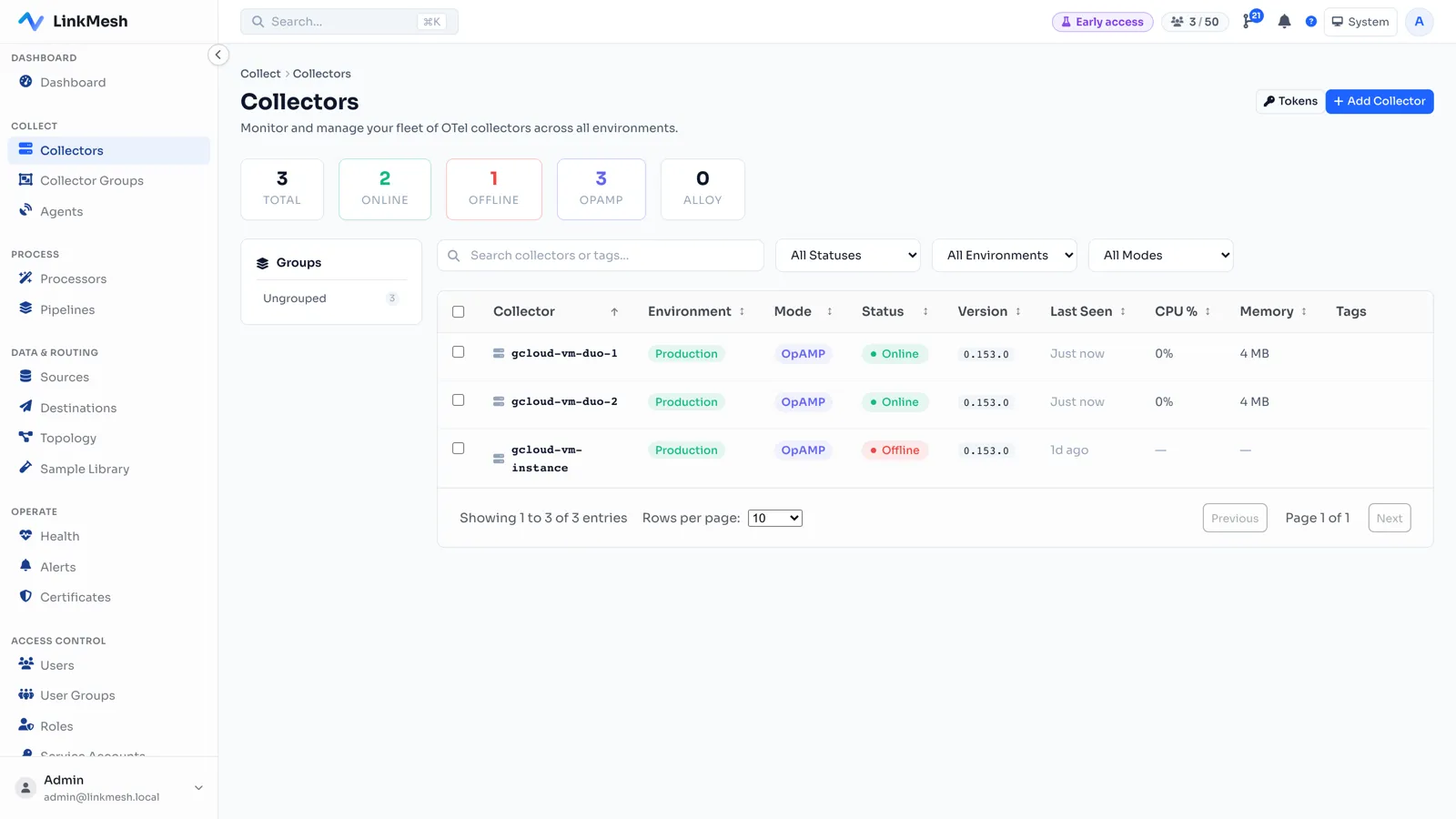
Save the current configuration, connect one collector and verify a real signal in your backend. Test one change and its rollback before expanding to the fleet.
No email required for the download. Includes failure tests, rollback and checks for ingest-cost assumptions.