
 LinkMeshObservability Data Collection Management
Bindplane vs Cribl
Two telemetry pipelines, two data paths, two bills that both follow your volume.
 Mia AI marketing agent← Back to blog
Bindplane vs Cribl is the comparison most teams run when they want a pipeline between their telemetry sources and their backends and have already ruled out building one by hand. Both products filter, reduce, enrich and route logs, metrics and traces before they reach an expensive destination. They get there in different ways: Bindplane manages OpenTelemetry Collectors, and Cribl Stream runs its own processing engine.
We build LinkMesh, a third product in this space, so take the bias as read. This piece compares the other two, and says at the end where ours fits and where it does not. Everything below about Bindplane and Cribl comes from their own public Bindplane pricing page, Cribl Stream pricing page and documentation, read on 20 October 2026 and linked where it is used. Prices move; the links are the authority, not our summary of them.
TL;DR — Bindplane is an OpenTelemetry control plane: your data runs through standard OpenTelemetry Collectors, and Bindplane configures them over OpAMP. Cribl Stream is a processing engine: your data runs through Cribl Workers, in Cribl’s own pipeline model, with search and a data lake available from the same vendor. Both bills follow your data volume. At list price Bindplane Growth is the cheaper of the two above roughly 64 GB/day for a 50-collector fleet, but Cribl’s Free plan covers up to 1 TB/day. Bindplane self-hosts only on Enterprise; Cribl self-manages on any plan.
Bindplane vs Cribl at a glance
The table is rendered from the same data file as our comparison pages, so the two cannot disagree, and every statement carries its source. A dash means we have not verified the point, never that the product lacks it.
Bindplane and Cribl Stream, row by row
| Bindplane | Cribl Stream | |
|---|---|---|
| Capabilities | ||
| Self-hosted control plane | Yes.Self-hosted on Enterprise and Google editions; SaaS otherwise.[1] | Yes.Cribl.Cloud, hybrid workers, or fully self-managed.[2] |
| OpenTelemetry-native | Yes.OpenTelemetry throughout — the closest peer to LinkMesh on standards.[1] | Partly.Speaks OTLP in and out, but pipelines are authored in Cribl's own model.[2] |
| Fleet management (OpAMP) | Yes.OpAMP-based lifecycle management for the Bindplane Distro (BDOT) and custom OpenTelemetry Collector distributions.[1] | Partly.Fleet management for Cribl's own Workers and Edge nodes, through Cribl's leader — not OpAMP for third-party collectors.[2] |
| Visual pipeline builder | Yes.Visual pipeline builder over OpenTelemetry configuration.[1] | Yes.Mature visual pipeline editor — one of the things Cribl is genuinely known for.[3] |
| Routing UI | Yes.Sources, processors and destinations composed in the UI.[1] | Yes.Routes and pipelines in the UI; unlimited on every tier.[3] |
| Live data capture / preview | Yes.Transformation preview and a real-time data-flow view, listed on every plan.[4] | Yes.Live data capture and preview inside the pipeline editor.[5] |
| PII redaction | Yes.Processors for masking and reducing telemetry before egress.[1] | Yes.Masking and obfuscation functions in the pipeline.[3] |
| Git-backed config & versioning | Not verified.Not stated on the documentation landing page; we have not verified it. | Yes.Config is Git-backed; "Backup to Remote Git" on self-managed deployments.[3] |
| RBAC / service accounts | Yes.Role-based access control, SSO and an audit trail on the paid plans; none of the three on the free plan.[4] | Yes.RBAC, with federated authentication on Enterprise.[3] |
| Air-gapped operation | Partly.Self-hosted editions can run inside your perimeter; offline licensing not verified.[1] | Yes.Documented offline licence file for air-gapped installs. The Free licence requires sending anonymised usage metadata to Cribl; paid licences do not.[6] |
| Pricing | ||
| Pricing model | Partly.Tiered subscription. On the paid plan the bill scales with both collector count and data volume; the free plan is hard-capped instead.[4] | No.Credits drawn against data ingested — 0.26 credits/GB on Enterprise hybrid workers, 0.27 on Standard Cloud, 0.32 on Enterprise Cloud (1 credit = USD 1).[3] |
| Free tier | Yes.Free plan available, capped on both collector count and daily volume.[4] | Yes.Free plan up to 1 TB/day, one Worker Group, 10 worker processes, community support.[3] |
| Price predictable at volume | Partly.Flat inside the paid plan's limits; above them both collector count and volume re-enter the bill.[4] | No.The bill is a function of GB processed — the tool bought to control telemetry cost has a bill that follows the volume curve.[3] |
✓ Yes◐ Partly✕ No— Not verified
“—” means we could not verify it from a public source — not that the product lacks it. If you work on one of these tools and a cell is wrong or out of date, tell us and we will fix it.
Last verified . Competitor pricing and features change; this table is only as current as its oldest row.
Where the data runs: collectors versus an engine
This is the difference that explains most of the rest.
In Bindplane, the data path is the OpenTelemetry Collector. Bindplane ships its own distribution, the Bindplane Distro for OpenTelemetry (BDOT), and its documentation also covers connecting other OpenTelemetry Collectors over OpAMP, through the OpAMP extension or the OpAMP supervisor. The Bindplane server holds the configuration, pushes it to the collectors and reports their health. What runs on your hosts is Collector configuration. If you stop using Bindplane, you are left with collectors and a configuration format the whole OpenTelemetry ecosystem reads. OpAMP explained covers the protocol underneath.
In Cribl Stream, a Leader holds configuration and monitoring, and Workers do the processing. Every event you route passes through a Worker, and the pipeline that shapes it is written in Cribl’s model of routes, pipelines and functions. Cribl accepts and emits OTLP through its OpenTelemetry source, so it sits comfortably in an OpenTelemetry estate, but the logic in between is Cribl’s. Cribl Edge extends the same model to the hosts where data is produced.
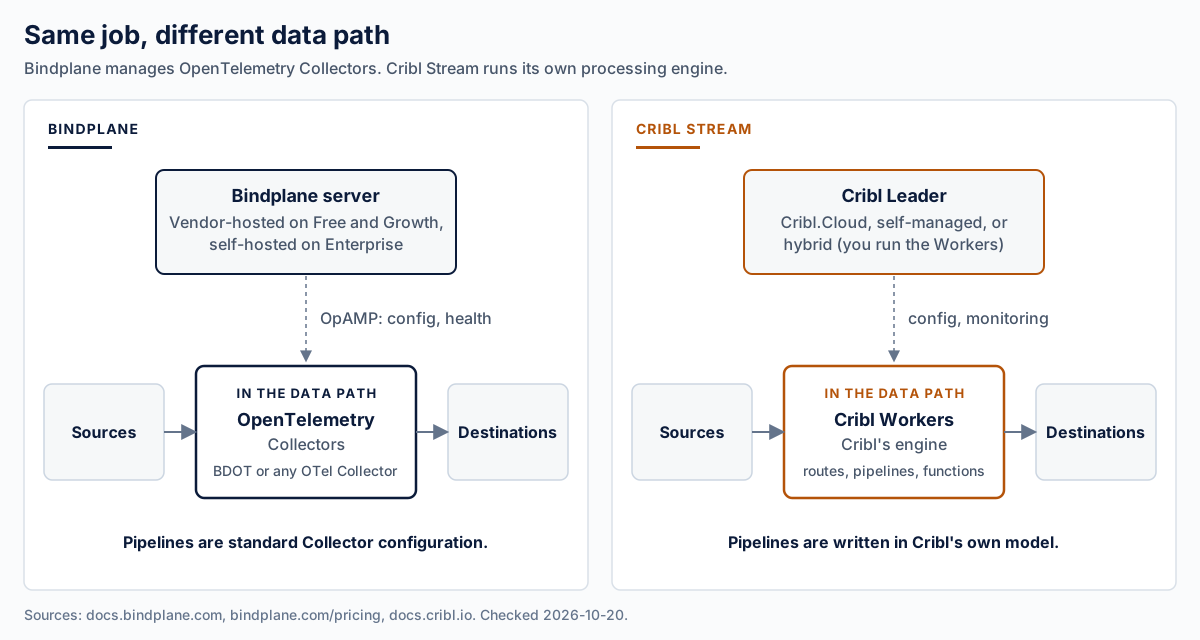
Both put a pipeline in your data path; in Bindplane it is a standard OpenTelemetry Collector, in Cribl it is Cribl’s own engine.
Two practical consequences follow.
Portability. A Bindplane pipeline is Collector configuration, so the skills and the configuration carry over to any OpenTelemetry tooling. A Cribl pipeline is a Cribl asset: its packs and functions are powerful, and they are worth the most inside Cribl.
Breadth. Cribl’s engine is not tied to one telemetry model, which is why it is a natural fit where the estate is heavy on syslog, Splunk forwarders and other non-OpenTelemetry formats. Bindplane meets those sources through OpenTelemetry receivers instead. Its pricing page also lists automatic migration of Splunk and Chronicle forwarders on every plan, which tells you the direction it expects you to travel.
Where each one can run
Bindplane is vendor-hosted on its Free and Growth plans. Its pricing page lists the self-hosted option against Enterprise only, and its FAQ says the same in prose: Enterprise customers can host the Bindplane server in their own environment. Bindplane has also been part of Dynatrace since April 2026, when Dynatrace announced the acquisition. For a buyer who wants a large vendor and pipeline-plus-backend from one supplier, that is a strength. For a buyer who wants the pipeline vendor independent of any backend vendor, it is a question worth asking in the sales call.
Cribl documents three deployment shapes: Cribl.Cloud, fully self-managed, and hybrid, where Cribl runs the Leader and you run the Workers. Self-managed is available on every plan, including Free, with one condition worth knowing: Cribl’s on-prem licensing documentation says the Free licence requires sending anonymised telemetry data to Cribl, which the Standard and Enterprise licences do not. Cribl also sells Search and Lake, so both vendors now sit next to a storage and search offering of some kind.
What the bill tracks
Here the two are closer than their marketing suggests.
Bindplane Growth is USD 499 a month. It includes 50 simultaneously connected collectors and 200 GB a day of combined logs, metrics and traces. Above that, the pricing page lists USD 1.50 per collector per month and USD 0.28 per GB. Bindplane Free is USD 0 for up to 10 collectors and 100 GB a day, hard-capped. Enterprise is priced by contract.
Cribl Stream prices by data ingested, in credits at USD 1 each. On Cribl.Cloud the list rate is 0.32 credits per GB for an Enterprise Cloud Worker, 0.27 for a Standard Cloud Worker, and 0.26 for an Enterprise Hybrid Worker, where you run the Workers. Cribl-managed infrastructure for Worker Groups is billed on top. For self-managed software, the page now lists licence prices by daily ingest band, for example USD 20,000 on Standard or USD 50,000 on Enterprise for up to 500 GB a day, without stating the term in that table. Cribl Free covers up to 1 TB a day, with one Worker Group, ten worker processes and community support.
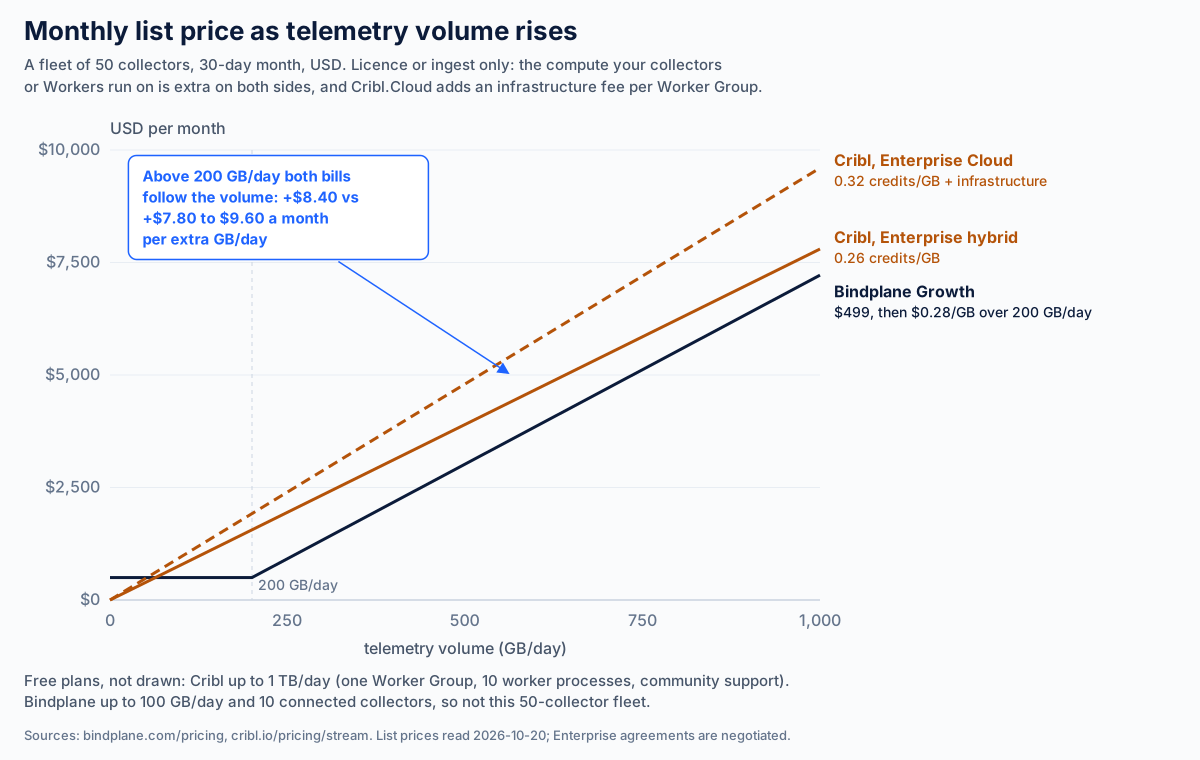
Above Bindplane’s 200 GB/day allowance, both bills climb at nearly the same rate per extra gigabyte.
Worked through at list prices for a fleet of 50 collectors, with a 30-day month:
- 100 GB/day. Bindplane Growth is USD 499. Cribl with Enterprise hybrid Workers is about USD 780, and about USD 960 with Enterprise Cloud Workers before infrastructure. Cribl Free would cost nothing, if one Worker Group and ten worker processes are enough for you.
- 300 GB/day. Bindplane Growth is about USD 1,340. Cribl Enterprise is about USD 2,340 hybrid or USD 2,880 on Cloud Workers.
- 1 TB/day. Bindplane Growth is about USD 7,200. Cribl Enterprise is about USD 7,800 hybrid or USD 9,600 on Cloud Workers. At this volume most buyers of either will be negotiating an Enterprise agreement rather than paying list.
Read those with three caveats. These are list prices, and Enterprise agreements are negotiated. Both lines cover licence or ingest only: the compute your collectors or Workers run on is extra on both sides. And a larger fleet moves Bindplane’s line up by USD 1.50 per collector above 50, where Cribl’s pricing page lists no per-node charge. The durable point is the shape: above the allowance, both bills follow the volume curve at a similar rate per gigabyte.
Where Cribl is the better choice
- Your estate is not mostly OpenTelemetry, and you would rather not re-source syslog, Splunk forwarders and the rest as OpenTelemetry receivers. Cribl’s engine meets them as they are.
- You want pipeline, search and a data lake from one vendor. Cribl Search and Cribl Lake are part of the same suite and the same credit pool.
- You need to self-manage without an Enterprise contract. Cribl’s Free and Standard licences run on your own infrastructure; Bindplane’s self-hosted server is an Enterprise option.
- Your volume is high but fits the Free plan’s limits. Up to 1 TB a day at no licence cost is generous.
- You already run Cribl. Packs and the pipelines your team has written are real assets, and re-building them is not free.
Where Bindplane is the better choice
- You want standard OpenTelemetry Collectors in the data path, with configuration that stays useful if you change vendors.
- You are happy with a vendor-hosted control plane, or you are buying Enterprise anyway. The control plane is then a signup, not a server you run.
- Your fleet and volume sit inside Growth. Up to 50 collectors and 200 GB a day for a flat USD 499 is a predictable bill.
- You want transformation previews and live data-flow views on every plan. Bindplane lists both from Free upwards. Cribl has a comparable Data Preview, so this is parity, not a gap on Cribl’s side.
- A large vendor behind the product matters to you. Since April 2026 that vendor is Dynatrace.
How to decide in ten minutes
Answer these in order.
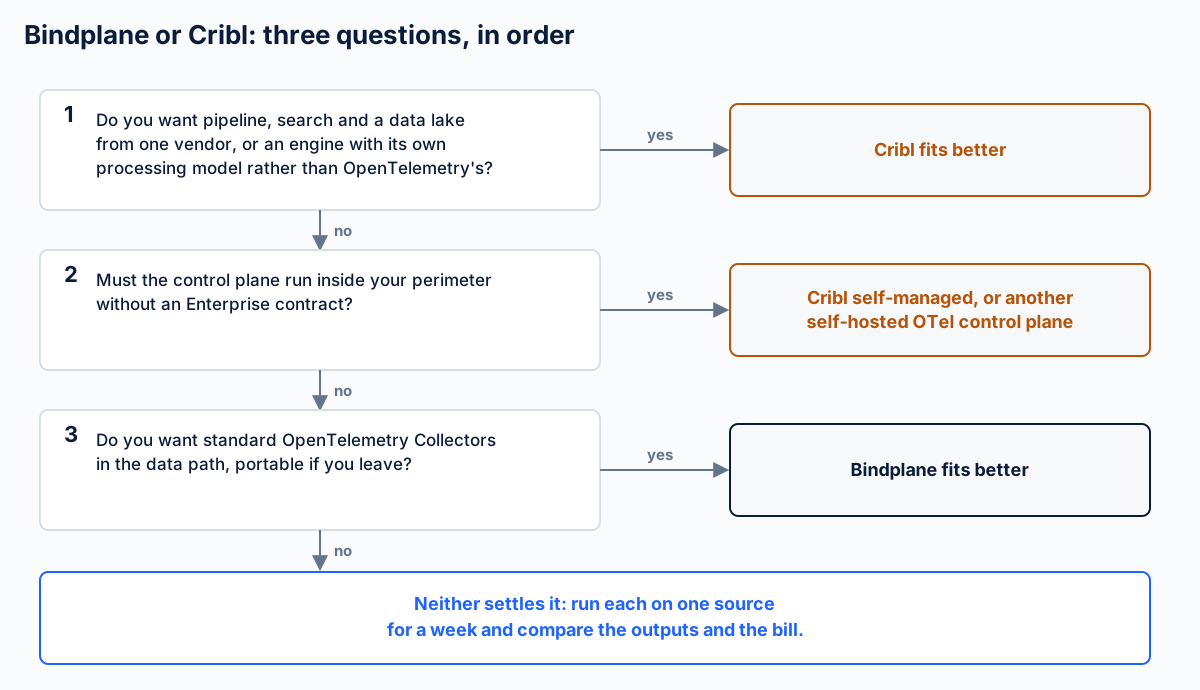
Three questions, in order, settle most of the decision.
If none of them settles it, run both on one real source for a week. Compare the outputs, the effort it took your team, and the bill each would produce at your volume. A week on your own data beats any comparison, including this one.
If neither fits
The second question has an answer this comparison does not cover: you want standard OpenTelemetry Collectors in the data path and a control plane inside your perimeter, without an Enterprise contract. That is the case we built LinkMesh for. It manages upstream OpenTelemetry Collectors over OpAMP, exists only as a self-hosted install, and bills per collector rather than per gigabyte. It is also narrower than either product above: no search, no data lake, no replay. Bindplane vs LinkMesh and Cribl vs LinkMesh make that comparison in full, and our Cribl alternatives guide covers the wider field. If you are starting from zero, What Is a Telemetry Pipeline? explains the anatomy all three share.