

 LinkMeshObservability Data Collection Management
Governance & Enforcement
Turn telemetry policy into rules that actually apply.
 Philippe Braxmeier← Back to blog
Every observability program eventually writes a policy document. “Redact PII before it leaves the host.” “Don’t ship debug logs to the expensive backend.” “Tag every signal with a team and an environment.” “Only these destinations are approved.” It’s a good document. It’s also, in most organizations, completely unenforced — a PDF that describes what should happen while every team runs its own collector config and does whatever it likes.
That gap between the policy and the pipeline is where governance fails. A rule that lives in a wiki and depends on each engineer remembering it isn’t governance; it’s a suggestion. Real governance means the policy is applied at the point telemetry is collected, uniformly, whether or not anyone remembers it exists.
OpenTelemetry gives you the machinery to close that gap — the Collector to apply rules, and OpAMP to push them to a whole fleet from one place. This guide is about turning telemetry policy into enforcement: what to govern, why raw collectors make it hard, and how a control plane makes the rules stick.
Platform leads, observability owners, and security/compliance stakeholders responsible for telemetry across many teams and collectors — anyone who has written (or been asked to write) a data-handling or cost policy and now needs it to actually hold in production. Prerequisites: a fleet of OpenTelemetry Collectors (or a plan for one) and the authority to standardize how they’re configured.
What “governance” actually means for a telemetry pipeline
Governance isn’t one control; it’s a handful of policies you want true of every pipeline in the estate, without exception:
- Data protection — sensitive fields (PII, secrets, tokens) are masked or dropped before telemetry crosses the network boundary, on every route, not just the ones someone remembered to configure.
- Cost guardrails — noise is filtered and high-volume streams are sampled so no single team can quietly 10× the bill. Volume control becomes a default, not a cleanup project.
- Standardization — consistent resource attributes (
service.name,deployment.environment.name, team/owner tags) so data is attributable and queryable across teams instead of a Tower of Babel. - Approved destinations — telemetry only flows to sanctioned backends. No rogue exporter quietly shipping production logs to an unvetted third party.
- Change control — every pipeline change is reviewed, versioned, and auditable, so “who changed what, when, and why” always has an answer.
Each of these is enforceable at the collector. The problem is making it enforceable at a thousand collectors, consistently, and keeping it that way.
Why raw OTel Collectors make enforcement hard
The OpenTelemetry Collector can express every one of those policies — redaction with
the transform and redaction processors, cost control with filter and
probabilistic_sampler, standardization with resource processors, routing to
approved exporters only. The capability isn’t the issue. The operating model is.
Out of the box, each collector is its own YAML file. That means:
- No central enforcement. A policy is only as good as its presence in every config. Miss one node and that’s your leak, your cost blowout, or your unattributed data.
- Config drift. Someone edits a collector by hand during an incident and forgets to revert. Now that node silently violates policy and nothing flags it.
- No preview, no safety. Push a bad redaction rule fleet-wide and you find out in production. There’s no “show me what this change does before it ships.”
- No audit trail. When an auditor asks “prove PII was masked on this pipeline on this date,” a pile of hand-edited YAML files is not an answer.
This is the honest reason many teams never get past the policy PDF: enforcing it by hand across a fleet is more work than anyone can sustain, so it decays. Governance that depends on discipline doesn’t scale.
The shift: from documented policy to enforced config
The fix is to stop treating each collector as an independently-editable box and start treating the fleet’s configuration as a single, governed artifact — rendered from policy, validated before it ships, pushed everywhere at once, and locked so it can’t drift.
Two OpenTelemetry building blocks make that possible:
- The Collector applies the rules — the processors that redact, filter, sample, standardize, and route.
- OpAMP (the Open Agent Management Protocol) is the remote-management standard that lets a central server own each collector’s config and push updates to the fleet. Crucially, when the server is the source of truth, local edits stop being authoritative — which is exactly what kills drift.
Put a control plane on top of those two and policy becomes config, config becomes enforced, and enforcement becomes provable.
How a control plane enforces it
This is where LinkMesh fits: it’s a self-hosted control plane for OpenTelemetry Collectors that turns each of those policies into something applied and provable, not documented and hoped-for.
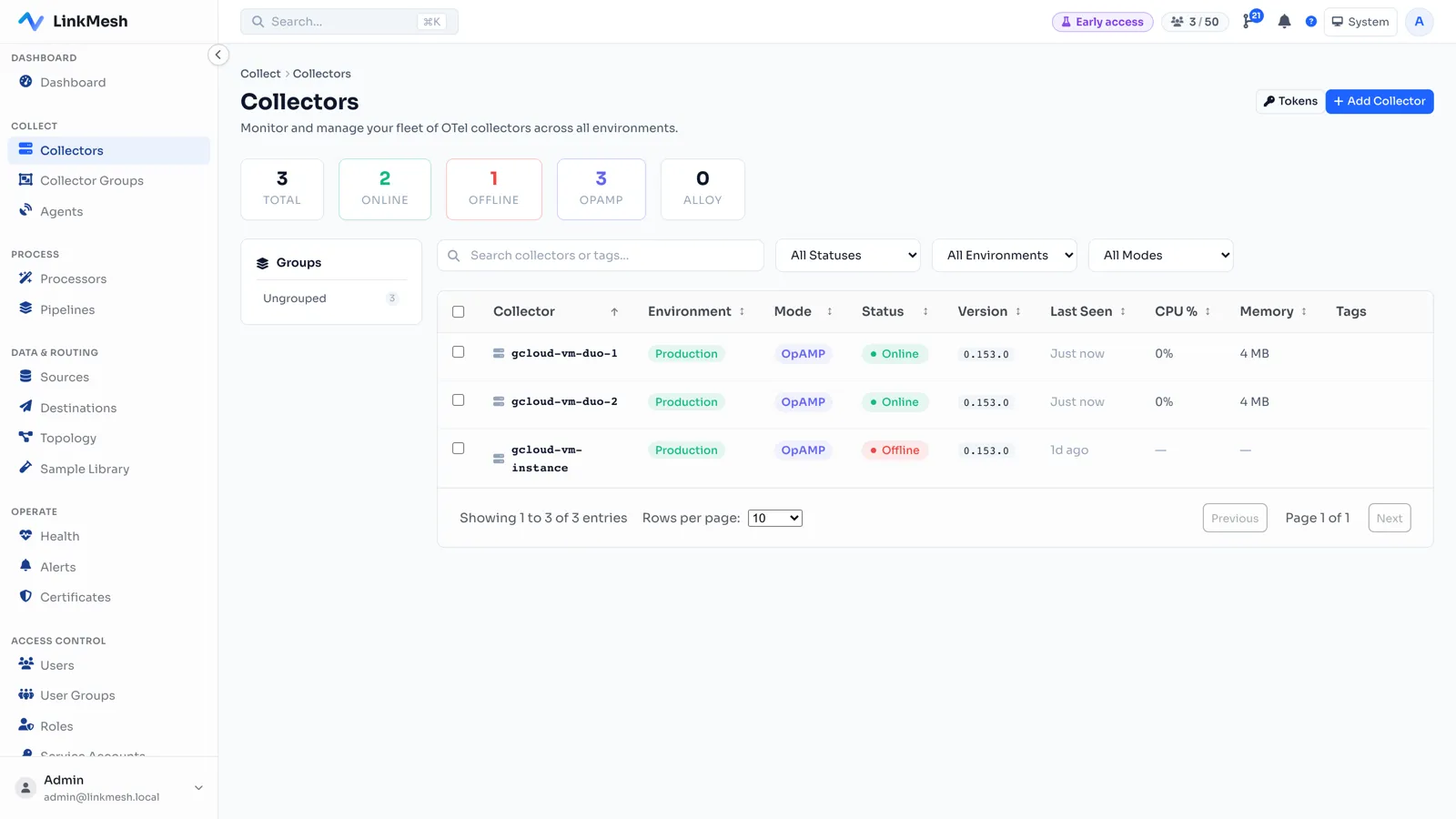
Central config as the source of truth. You compose sources, processors, routes, and destinations once, in a visual builder. LinkMesh renders and validates the collector config and delivers it to the right nodes — OpAMP push or remotecfg pull. Because the control plane owns the config, a hand-edit on a node isn’t authoritative — the enforced config is. That’s drift prevention by design, not by policing.
Mandatory processing on every route. Redaction and filtering aren’t optional add-ons a team can skip; they’re steps in the pipeline the control plane ships. Put a PII-redaction processor in the standard pipeline and it applies everywhere that pipeline is deployed — the enforcement mechanism behind the practice we cover in PII masking in logs.
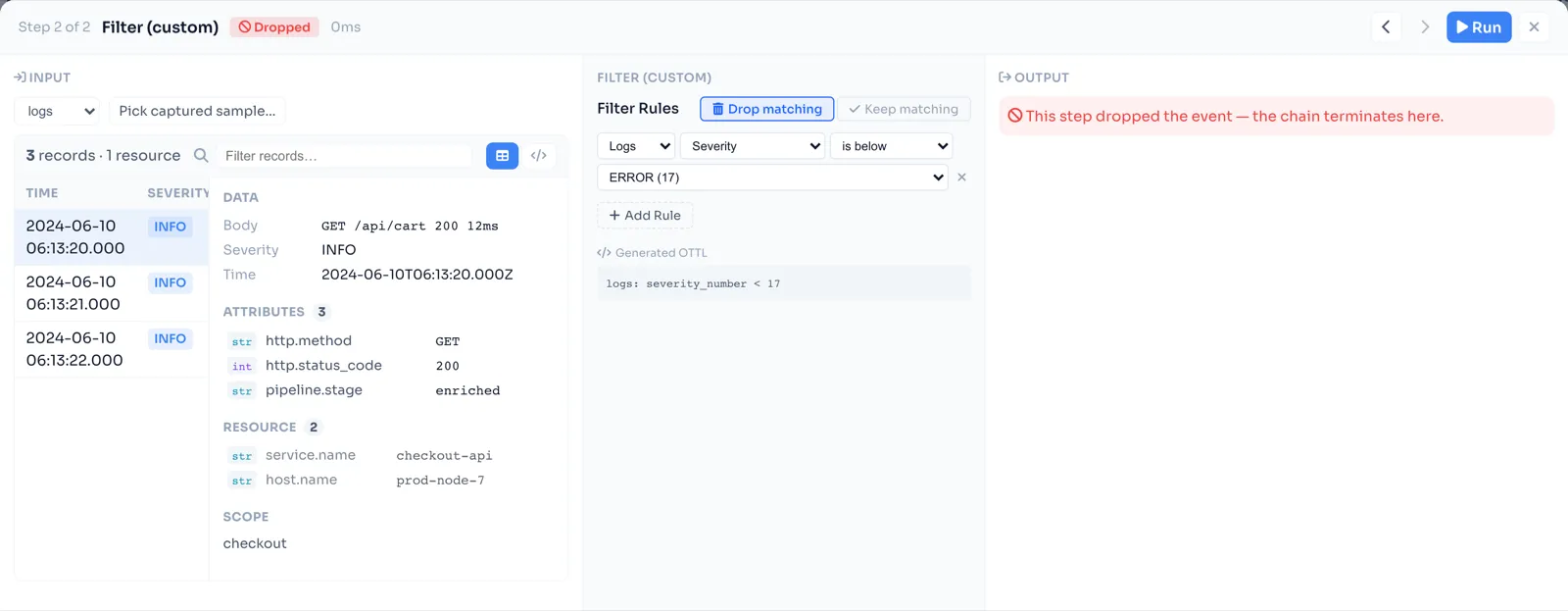
Preview before you enforce. A governance change you can’t test is a governance change you’re afraid to make. LinkMesh previews a processor’s effect — input, config, output — so you can confirm a redaction or drop rule does exactly what you intend before it ships to the fleet:
An audit trail of what actually shipped. Every config change is versioned and recorded — GitOps-style — so “who changed what, when, and why” always has an answer. That’s the difference between claiming a policy and being able to prove it held on a given date, which is what compliance actually asks for. (The mechanics are in GitOps for collector config.)
Verification, not faith. Enforcement you can’t observe is just hope. LinkMesh shows per-edge throughput and per-processor drop counts, so you can watch a governing rule take effect — see the redaction applied, see the sampled stream shrink — and confirm the policy is live rather than assumed.
Governance without a new cost meter
There’s a trap worth naming. A governance layer that bills by the volume it inspects becomes its own cost problem — the more you govern, the more you pay, which quietly discourages governing everything. LinkMesh is priced per managed collector, not per gigabyte, so enforcing policy across your whole fleet doesn’t add a usage meter on top of the backend one you’re trying to control. And because the telemetry never flows through the control plane — it stays on your infrastructure, routed straight to approved destinations — the governance layer isn’t a new place for sensitive data to sit, either.
This also compounds with the cost work: the same enforcement that redacts PII and standardizes attributes is where you drop noise and sample volume, so governance and observability cost control are the same set of rules, applied in the same place.
Where to start
You don’t have to govern everything on day one. Enforce the highest-stakes policy first and expand:
- Redaction first — put a PII-masking processor in the standard pipeline so sensitive data is masked at the edge, everywhere, by default.
- Cost guardrails next — add filter and sampling defaults so no team can balloon the bill unnoticed.
- Standardize attributes — enforce
service.name, environment, and ownership tags so every signal is attributable. - Lock destinations and audit — restrict routing to approved backends, and keep the versioned trail of every change.
Governance stops being a document the moment the rules live in the config the fleet actually runs. OpenTelemetry gives you the collector and OpAMP to make that real; a self-hosted control plane makes it enforceable, previewable, and provable — which is the whole point of governance in the first place.
LinkMesh turns a data-handling or cost policy into validated collector config, delivers it to every node (OpAMP push or remotecfg pull), previews each change before it ships, and keeps an audit trail of what shipped and when. Self-hosted, priced per collector. Stand up a control plane and enforce your first policy in minutes, or see what it does and the pricing.