

 LinkMeshObservability Data Collection Management
Config Rollout & Rollback
Change the fleet without breaking it.
 Roman Hüsler← Back to blog
The most common way to break an observability pipeline isn’t a hardware failure or a traffic spike — it’s a config change. Someone edits a processor, fixes an endpoint, or tightens a filter, pushes it to the fleet, and a typo or an over-broad rule quietly drops the telemetry you need an hour later during an incident. The change itself is routine; the way it’s rolled out is what makes it safe or dangerous.
This guide is about treating collector config change like the production deploy it actually is: validated before it ships, rolled out gradually, versioned so there’s always a known-good to return to, and reversible in seconds rather than in a frantic round of SSH sessions.
Platform engineers and SREs who change OpenTelemetry Collector config across more than a handful of nodes and have felt the risk of pushing an edit everywhere at once. Prerequisites: a collector fleet and a desire to stop hand-editing YAML per node. Related reading: GitOps for collector config and OpAMP explained.
Validate before you apply
Most bad rollouts are caught for free if you validate the config before it reaches a node. The Collector can check a config without running it:
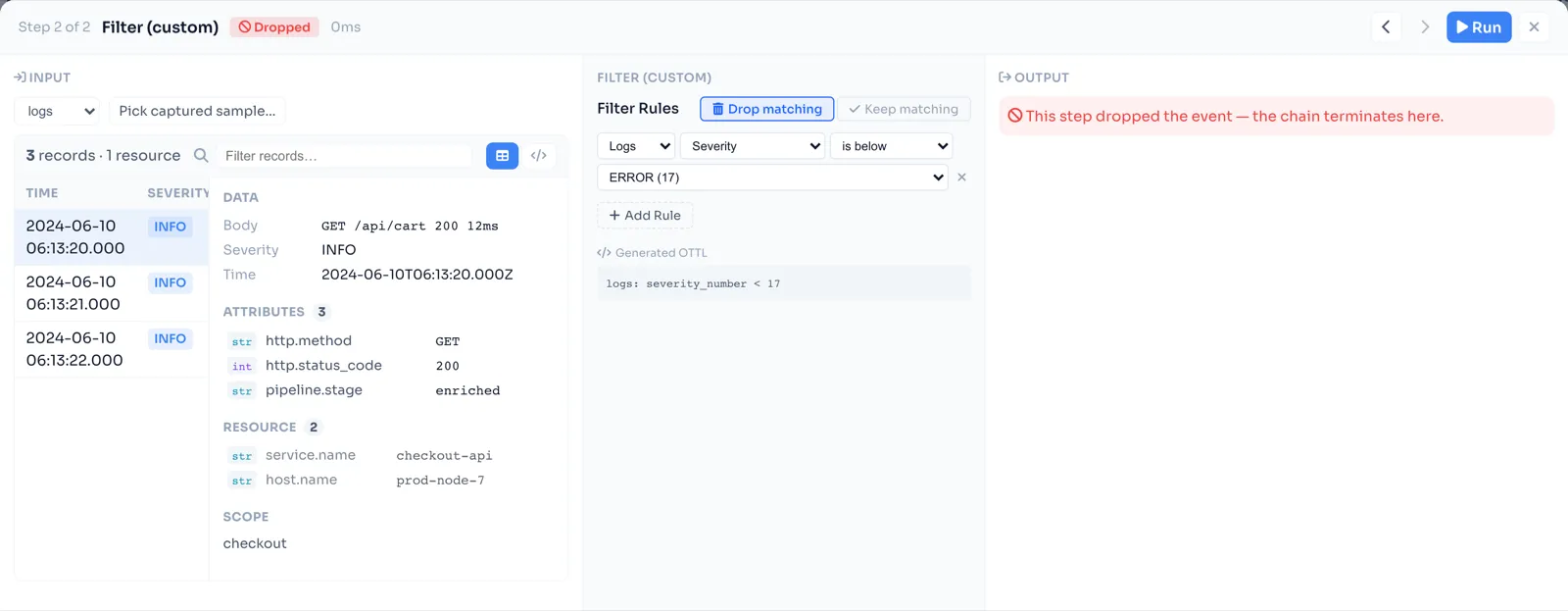
otelcol-contrib validate --config config.yamlValidation catches structural errors — an unknown processor, a receiver referenced in a pipeline but not defined, a malformed exporter block — before they take a collector down. But structural validity isn’t behavioral correctness: a config can be perfectly valid and still drop every span because a filter is inverted. So the second half of “validate” is a preview — showing what a processor actually does to sample input before it ships. Seeing a keep-only-errors filter drop the right records on real data catches the mistakes that a schema check never will.
Roll out in stages, not all at once
Even a validated, previewed change should not hit every collector simultaneously. A staged (canary) rollout limits the blast radius of anything the earlier checks missed:
- Canary. Apply the new config to a small, representative subset — one node, one zone, or one non-critical service — and leave the rest on the current version.
- Watch. Give it long enough to see real traffic. Compare throughput and drop counts on the canary against the unchanged nodes. A healthy rollout looks boring: volume holds, drops don’t spike, no errors in the logs.
- Expand. Once the canary is clearly healthy, widen to the next tier, then the rest of the fleet. If anything looks wrong at any step, you stop and roll back the canary only — the blast radius never grew past the subset.
The whole value of canarying is that a mistake affects one node for ten minutes instead of a thousand nodes indefinitely. That only works if you’re actually watching the right signals during the soak, which is why observing the effect of a rollout (below) is part of the process, not an afterthought.
Versioned config is the source of truth
Fast rollback is only possible if there is a last-known-good version to return to — which means every config is versioned and the fleet’s running state is derived from those versions, not from whatever someone last typed on a box. Treat config as a versioned artifact (GitOps style): each change is a new version, reviewed and recorded, and the node runs the version it was assigned. This is the foundation the whole GitOps approach to collector config is built on, and it’s what makes drift detectable and rollback trivial.
Without versioning, “roll back” means reconstructing the previous config from memory under pressure. With it, rollback means re-pushing a specific earlier version — a diff you can read and an artifact you can trust.
Roll back fast
When a rollout goes wrong, speed matters more than diagnosis. The right first move is to restore service, then investigate:
- Revert to the last-known-good version. Select the previous config version and re-push it to the affected nodes. Because it’s a version, not a reconstruction, you know exactly what you’re restoring.
- Confirm recovery. Watch throughput and drop counts return to their previous baseline on the reverted nodes.
- Then diagnose. With service restored, work out what the bad change did — using the previewed diff between the two versions — before trying again.
Rollback should be a button, not a project. If reverting a fleet-wide change requires editing YAML on every node, you don’t really have rollback; you have a second, riskier rollout under time pressure.
Why OpAMP and a control plane make this first-class
All of the above — push a version to a subset, watch, expand, revert — is painful to do by hand because raw collectors are independent YAML files with no shared notion of “version” or “assigned config.” OpAMP, the Open Agent Management Protocol, is the standard that lets a central server own each collector’s config and push updates to the fleet. That’s the primitive that turns rollout and rollback from per-node SSH into a fleet operation:
- Targeted apply. Push a version to a labeled subset (the canary) and leave the rest untouched — because the control plane knows which node runs which config.
- Atomic revert. Re-assign the last-known-good version to the affected group and the control plane pushes it everywhere at once.
- No drift after apply. Because the server is authoritative, a node can’t quietly keep a hand-edit — the assigned version is what runs, which is exactly what detecting config drift is about.
A self-hosted control plane like LinkMesh puts this on top of OpAMP: compose a config in the visual builder, validate and preview it, push it to a single canary collector first, watch its per-edge throughput and per-processor drop counts to confirm health, then publish to the whole fleet — or revert the fleet to a prior version in one action. It’s the same enforcement machinery behind governance at scale, applied to the day-to-day act of changing config safely.
Observe the effect
A rollout isn’t “done” when the config is applied; it’s done when you’ve confirmed the fleet is healthy on the new version. That means watching the signals that reveal a bad change:
- Throughput per edge — did volume hold, or did a route go quiet because a receiver or exporter broke?
- Drop counts per processor — did a filter or sampler start dropping far more (or far less) than intended?
- Collector errors and restarts — is the new config causing crashes or export failures?
If those hold steady across the canary and then the fleet, the rollout is genuinely healthy — not just applied. That confirmation is what lets you expand with confidence and, if it’s ever missing, what tells you to roll back before the blast radius grows.
LinkMesh makes rollout and rollback first-class: validate and preview a change, push a version to a single canary collector, watch per-edge throughput and drop counts, then publish to the fleet — or revert the fleet to the last-known-good version in one action, over OpAMP. Self-hosted, versioned, audited. Stand one up in minutes, or see what it does.